Variable Speed Foot Switch Applications and Advantages
June 20, 2012Hallmark Industries DC Motors
July 18, 2012Controlling AC Motors
AC motors are essential in many applications, particularly within industrial settings where motors are needed to power heavy-duty machinery. For plants and facilities that depend on accuracy and timeliness, proper regulation of these electric motors is crucial. Controlling AC motors maintains process optimization, safety and energy efficiency. Discover different methods to control AC electric motor speed and frequency for efficient, safe operations.
How to Control AC Motor Speed
Certain components need to be modified to control the AC motor speed. Some of the ways to regulate the AC motor include:
- Changing the number of poles in very small increments: This technique is rarely used because of its inefficiency in continual control needs in demanding operations.
- Changing the motor’s slip: This method is best used for motors designed for high slip. It requires the motor to match the load while also ensuring that the change in power results in the correct change in load speed. The load needs substantial inertial components.
- Changing the frequency of the AC signal: The most common way of controlling AC motor speed is by changing the motor’s frequency. This method adjusts the speed through variable speed AC motor drives.
Selecting the Right AC Motor Control Method
Many applications require precision to keep the operation running smoothly. Consider the various AC motor speed control methods if you operate a plant or facility where AC motors are used to power pumps, fans and other heavy-duty equipment. To select the best technique, analyze key factors such as:
- Application requirements
- Motor type
- Load characteristics
Highly Efficient Method to Control AC Motor Speed
Controlling motor speed with the AC frequency serves as the standard in AC motor operations. AC motors fundamentally operate based on the frequency of the given power, so adjusting frequency is the best way to alter and manipulate motor speed. Motor speed adjustment depends on variable frequency drives (VFD), AC inverters and adjustable speed drives (ASD). The AC frequency can be adjusted using:
- Six-step inverter: Also referred to as a variable voltage inverter, it rectifies the AC power to DC power and then switches to imitate a sine wave.
- Vector flux: This method manipulates the three-phase stator current to influence the rotor flux vector and rotor current. It’s available on equipment with standard inverters that operate under vector flux control.
- Pulse-width-modulation: With pulse-width-modulation, DC voltage is swiftly changed to match the “area under a curve.”
Advantages of Installing AC Drives
The easiest method is to install reliable AC drives designed to accurately control the speed. This technique allows a variety of control settings and mounting options so you can easily find controls to meet your application needs. Installing AC drives is great for:
- Acceleration control
- Smooth machine operation
- Production rate adjustments
- Tension control capabilities
- Energy savings
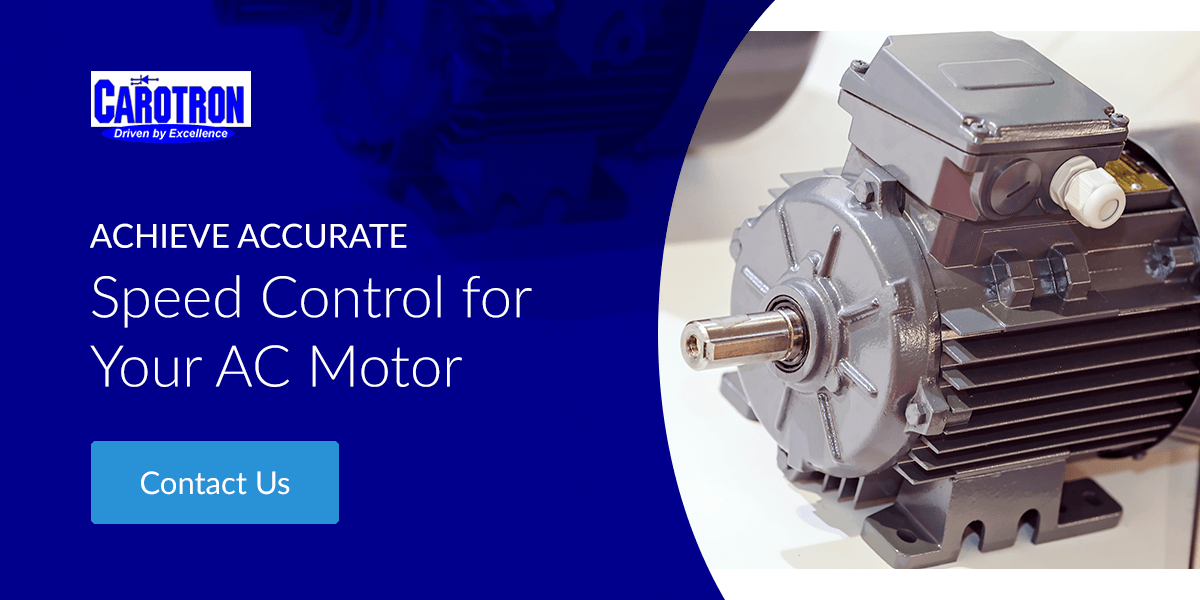
Achieve Accurate Speed Control for Your AC Motor
Synchronization between the AC motor and speed control is crucial for precise matching and optimized performance. Find the right AC electric motor with speed control for your operations. Contact us today for a free quote.